The regulated stablecoin opportunity

A new kind of money is emerging — regulated, local, and instant.

Stablecoins issued under real regulatory frameworks — in local currencies and in the world's reserve currencies like the US dollar and euro — are set to remake payments: cutting the time, cost, and friction of today's rails, and folding remittances and everyday spending into one instant system. Ease Send is the infrastructure built to carry it, for everyone who touches a transaction.

The opportunity

Sub-Saharan Africa moved $205B on-chain last year. Regulators are racing to bring it into the light.

This isn't a speculative market. It's retail-sized, everyday money — remittances, merchant payments, savings — increasingly moving as stablecoins rather than cash or bank transfers. What's been missing is a rail built for the rules regulators are now writing.

$205B
On-chain value received in Sub-Saharan Africa, twelve months to June 2025
52%
Year-on-year growth — the third-fastest of any region on earth
43%
Share of the region's crypto volume that's already stablecoins, more than double Bitcoin's

Source: Chainalysis, 2025 Geography of Cryptocurrency Report and 2025 Global Crypto Adoption Index.

And that growth isn't an isolated story — it's near the top of a fast-moving global picture. Year-on-year growth in on-chain value received, July 2024 to June 2025:

Bar chart: year-on-year growth in on-chain value received by region, July 2024 to June 2025 — APAC 69%, Latin America 63%, Sub-Saharan Africa 52%, North America 49%, Europe 42%, MENA 33%.

Source: Chainalysis, "Sub-Saharan Africa Shows Strong Crypto Retail Activity" and 2025 Global Crypto Adoption Index.

And within that volume, the instrument has changed. Stablecoins now carry more than double Bitcoin's share of the region's crypto activity — money people spend, not an asset people hold.
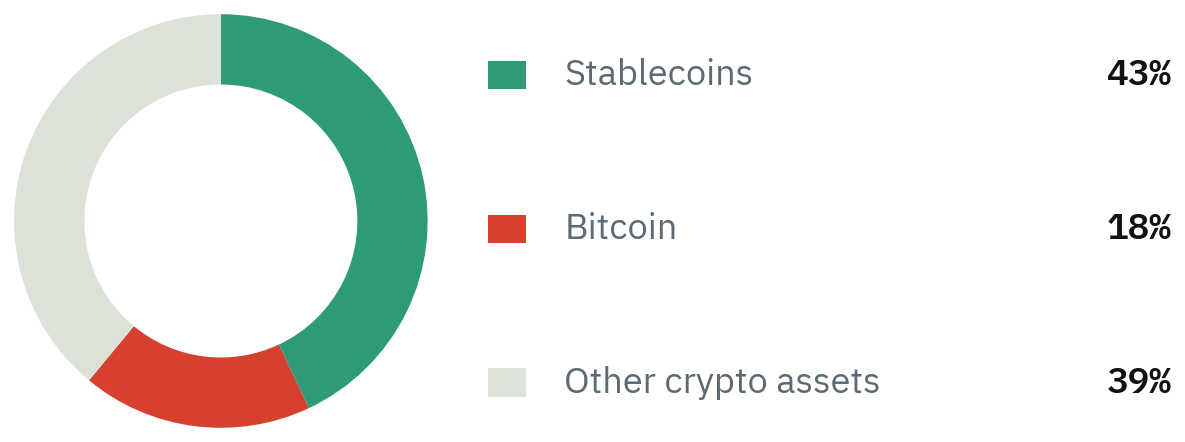
Donut chart: share of Sub-Saharan African crypto transaction volume, 2024 — stablecoins 43%, Bitcoin 18%, other crypto assets 39%.

Share of Sub-Saharan African crypto transaction volume, 2024. Source: IEEE Computer Society, "Stablecoins and Financial Inclusion in Africa," citing Chainalysis 2024 data.

Sending money into the region costs roughly 9% of the amount sent, against a 6.4% global average. Kenyan households alone received KSh 932B in remittances in a year, 91% of it landing as cash:
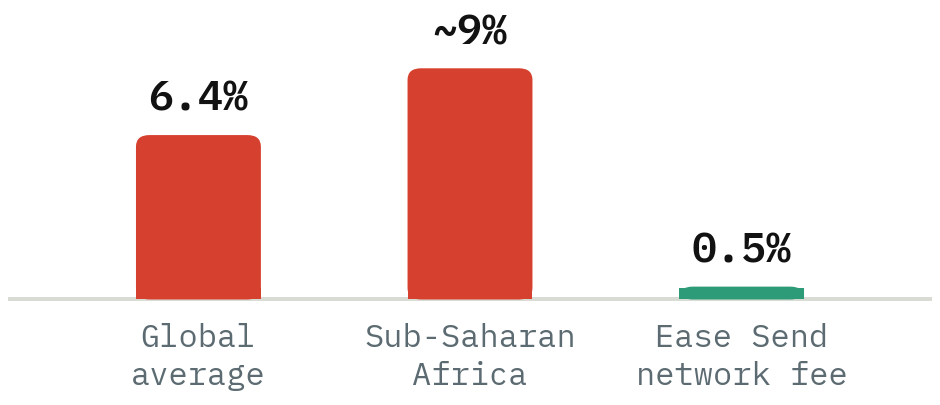
Bar chart: cost of sending US$200 — global average 6.4%, Sub-Saharan Africa about 9%, Ease Send network fee 0.5%.

Cost of sending US$200, share of amount sent. Ease Send's figure is its on-chain network fee — 0.5% of the transaction, uncapped, paid in the coin sent. A payment processor fee of roughly 1–2% may apply depending on route; redeeming directly from the issuer carries no processor fee. Sources: World Bank Remittance Prices Worldwide, Q1 2025; Ease Send technical specification.

A regulated stablecoin, spendable the instant it arrives, removes that cost and the extra conversion step entirely.

Kenya leads

Kenya's Virtual Asset Service Providers Act was assented into law in October 2025 and commenced that November; its detailed Regulations were gazetted in July 2026. The Central Bank of Kenya now licenses stablecoin issuance directly, under a framework that requires direct, on-demand redemption for every holder — the one requirement none of the major global stablecoins are built to meet.

15 Oct 2025
VASP Act No. 20 of 2025 assented.
4 Nov 2025
Act commences — virtual asset services become a regulated activity.
22 Jul 2026
VASP Regulations gazetted, with capital rules and direct-redemption requirements.

Building elsewhere in Africa

Nigeria

Africa's largest crypto market brought digital assets under formal securities oversight through the Investments and Securities Act 2025, with the central bank now opening the door for licensed banks to work with regulated providers.

South Africa

The most mature licensing regime on the continent — the Financial Sector Conduct Authority has already approved roughly 300 virtual asset service providers.

Mauritius

One of Africa's earliest digital asset frameworks, in place since 2021, is now being extended with dedicated stablecoin guidance.

Ghana

Parliament has passed a dedicated Virtual Asset Service Providers Act, adding another gazetted framework to the region.

Also drafting or exploring frameworks of their own: Ethiopia, Rwanda, Tanzania, Uganda, Zambia, Botswana, Namibia, Seychelles, and Morocco.

And for the currencies the world already trusts

US Dollar

The GENIUS Act, signed into US federal law in July 2025, created the first federal licensing and reserve framework for dollar-backed payment stablecoins.

Euro

The EU's MiCA regulation now governs euro-denominated e-money tokens directly, with authorized issuers already live across more than a dozen member states.

The pattern repeats everywhere: large-scale, informal stablecoin use already exists, and regulators are moving to bring it inside a licensed, transparent system — in local currency, and in the currencies that already cross every border. Ease Send is built for exactly that system, in Kenya first.
For the people sending, spending, and getting paid

Money that moves like a message.

No browser extension, no seed phrase to memorize, no second token just to cover a fee. Ease Send is built so that using a compliant stablecoin feels like using a messaging app — because a lot of the same technology is under the hood.

For individuals

Send it, spend it, keep it

  • Remittances land ready to spend — no cash pickup, no separate conversion step, and none of the roughly 9% typically lost to fees along the way.
  • Pay with a fingerprint. A passkey — the same Face ID or Touch ID that unlocks the phone — signs every transaction. No password, no seed phrase to remember day to day.
  • One balance covers everything, including the fee — no second token to buy or top up just to send money.
  • The signing key is split between the device and the cloud, and only reconstituted for an instant to sign. No one else — not even Ease Send — can ever produce a usable key alone.
  • Send a payment request or split a bill in the same app — encrypted group chat is built in, not bolted on.
For businesses & merchants

Get paid, and put it to work immediately

  • Payment, processor fee, and network fee settle together, automatically — no manual invoicing or reconciliation.
  • Money keeps moving on weekends and holidays. A Saturday's sales become Saturday's working capital, not Monday's, because settlement isn't tied to interbank hours.
  • Fees undercut card interchange, with zero chargeback exposure.
  • Works with the QR codes and POS terminals already in place — no new hardware to install.
  • Send payment requests, receipts, and order updates straight to the customer — encrypted, and included at no meaningful cost.

What it feels like at the counter:

Step 01

Scan the code

The terminal shows a dynamic QR carrying amount, currency, merchant account, and payment reference. Nothing is typed.

Step 02

Confirm with a fingerprint

A passkey signs the transaction using Face ID or Touch ID — biometric authentication already built into the device.

Step 03

Merchant is notified

Payment, processor fee, and network fee execute together. The till receives confirmation instantly.

Step 04

Fiat lands in the bank account

The merchant wallet auto-forwards to its bank with account details attached. The bank credits local currency.

And why it never gets stuck:

Every other major network

Two balances, two points of failure

5,000 USDT + 0 ETH — the money, and separately, the gas. Transaction rejected: the customer has money and cannot spend it.

Ease Send

One balance, spendable to the last cent

5,000 USDX — the money, and the fee, paid from it. Payment settles: 100% of the balance is always spendable.

Credit cards typically take one to three business days to settle and charge 2–3.5% in interchange. Mobile money is fast for the wallet-to-wallet leg, but still waits on bank hours to become spendable fiat. A stablecoin that never converts back to fiat waits on nothing:

Payment railTypical feeTypical settlement
Credit cards~2–3.5% interchange, plus card fees1–3 business days to reach the merchant
Mobile moneyTiered fees by amount; merchant till fees around 0.5%Instant to the wallet — bank withdrawal still runs on business hours
Ease Send, converted to fiat0.5% network fee, uncapped — plus a processor fee of roughly 1–2% if one is used; none if redeemed direct from the issuerUnder 2 seconds on-chain; fiat credit follows from there
Ease Send, staying in stablecoins0.5% network fee — nothing elseUnder 2 seconds, always. Nothing left to wait for.

Sources: typical US card-processor interchange and funding guides; M-Pesa Till (Buy Goods) merchant fee of 0.5%, capped at KSh 200, per Safaricom's 2026 tariff; Ease Send technical specification.

For banks, payment switches & PSPs

One integration reaches the whole market.

Card and POS traffic already concentrates through national switching infrastructure. Plugging into Ease Send once gives a bank, switch, or payment provider reach across that entire network — without building a blockchain, a wallet, or a compliance pipeline from scratch.

What Ease Send provides

The rails

  • The blockchain, audited smart contracts, and gasless fee model
  • Non-custodial key generation and signing for every end user
  • The gated transaction explorer, with full access for the relevant authorities
  • Built-in end-to-end encrypted messaging for payment requests, receipts, and customer notifications
  • User-facing apps, APIs, and white-label interfaces — see the API docs
What you gain

New income, less overhead

  • A conversion fee on every automated redemption you process
  • A merchant-acquisition edge — fees below card interchange, zero chargeback exposure
  • Fresh deposit inflows if you're also the point of purchase for the stablecoin
  • No custody, and no support queue for lost seed phrases — the key was never yours to hold

Every party — merchant, switch, network, and bank — is paid automatically inside the same transaction, with nothing to invoice or reconcile after the fact.

For the institution that issues the coin

Everything but the treasury and the license.

Becoming a stablecoin issuer means holding the reserve and the regulatory relationship. Ease Send automates everything else the protocol can handle.

Automated

Minting & redemption

Issued and redeemed against reserve automatically, matching what the regulation requires — direct, on demand, for every holder.

Automated

Freezing & blocking

Regulatory account freezing and blocking, available on demand, without ever taking custody of a user's key.

Automated

Reporting

Circulation and reserve composition data, structured for the monthly and daily reports regulators require.

As issuer, you hold a 1:1 fiat treasury in investment-grade instruments and keep the yield it generates — the same model global issuers have already proven, now under a framework that actually lets you meet the law: direct redemption, on demand, for every holder.

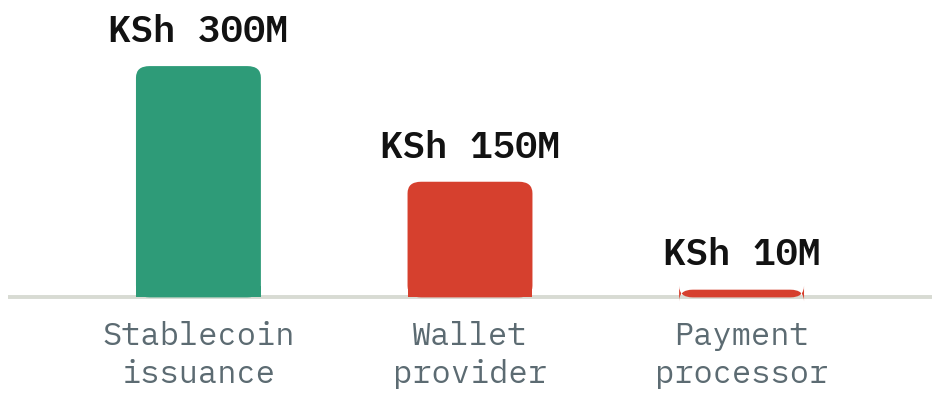
The paid-up capital bar rises fast by licence class — issuing the coin itself carries by far the largest requirement:

Bar chart: Kenya VASP paid-up capital by licence class — stablecoin issuance KSh 300M, wallet provider KSh 150M, payment processor KSh 10M.

Paid-up capital by licence class, Kenya VASP Regulations 2026, Fifth Schedule — full paid-up and liquid figures below.

What it takes to get licensed in Kenya

Licence classPaid-up capitalLiquid capital
Stablecoin issuanceKSh 300MKSh 60M
Virtual asset wallet providerKSh 150MKSh 30M
Virtual asset payment processorKSh 10M100% of 30-day liabilities

The Central Bank of Kenya licenses stablecoin issuance directly and must decide a complete application within 30 days. Ease Send can also help with the approval process itself, and with integrating third-party KYC/AML providers like SmileID into onboarding.

None of the dollar stablecoins already circulating in East Africa were built to meet a direct-redemption requirement — Kenya's regulations make that mandatory. A compliant, locally issued coin is structurally defensible in a way an adapted global stablecoin can't be.

For central banks & regulators

Full visibility, without exposing your citizens.

A public blockchain forces an uncomfortable choice: total transparency for anyone with a block explorer, or no visibility at all. Ease Send is built to give regulators everything they need — and give everyone else nothing more than that.

Gated, not public

Only the parties involved can read a transaction

A transaction is visible to its sender, recipient, and issuer — plus the relevant authorities, with full access as required by law. A stranger with a block explorer link learns nothing about a citizen's finances.

Structured, not just a hash

The ledger entry is the audit record

Every transaction already carries the originator, beneficiary, institution, account, and reference a compliance officer needs — the same fields Kenya's rules require licensees to report monthly and reconcile daily.

Enforced, not promised

Redemption is how the system works

Direct, on-demand redemption isn't a policy an issuer agrees to follow — it's built into the protocol. Consumer protection doesn't depend on an audit finding it later.

Enforcement without custody

Accounts can be frozen for cause

Regulatory freezing and blocking is available on demand, without Ease Send, the issuer, or any government ever holding a user's private key.

The activity this data describes is already happening — Sub-Saharan Africa's $205B in on-chain value proves that. The question was never whether to allow it, but whether to bring it inside a system built for oversight. Ease Send is that system.

Built in

Every transaction can come with a conversation.

Ease Send pairs its wallet with its own end-to-end encrypted messaging system — for discussing a payment, sending a payment request, or notifying someone it's arrived, without leaving the app or trusting a separate one.

Extremely low cost

A small, flat fee per message

Sending a message costs a fraction of what it costs to move money — cheap enough to use for every payment request and notification, not just the important ones.

Rich by default

Images, links, and emoji — not just text

Attach a receipt, a photo, or a link to an order alongside a payment request. It's a messaging app first, built for payments — not the other way around.

Group-ready

Split a bill or coordinate as a group

Group messaging is included, so a family coordinating a remittance or friends splitting a bill can talk it through in the same thread the payment happens in.

Post-quantum encrypted

Built on Signal's own protocol

Messaging runs on Signal's libsignal, hardened against future quantum decryption — the same encryption standard trusted for some of the most sensitive conversations in the world.

This is a different kind of privacy than the transaction ledger's. A payment's structured data is gated — visible to its parties and, as required by law, to regulators. A message about that payment is end-to-end encrypted — visible to no one but the people in the conversation, not even Ease Send.

Non-custodial by design

The key exists in one place — split in two, and only for an instant.

When an account is created, its master key is generated inside a secure enclave, sealed with a decryption key made from two separate secrets, then deleted. Reconstituting it — even briefly — takes both.

Step 01

You authenticate

Face ID, Touch ID, or your device's authenticator produces a fresh biometric secret — yours alone, never stored anywhere.

Step 02

The enclave reconstitutes the key

Briefly, by combining your biometric secret with a separate secret from the cloud key management system. Neither one works alone.

Step 03

The transaction signs

The enclave signs the proposed transaction, turning it into a signed transaction ready for the network.

Step 04

The key is wiped

Immediately erased from memory. What remains at rest is the sealed key — useless without both secrets and a live authentication.

Every account also gets a recovery seed phrase, generated alongside the master key and sent to the device in encrypted form — unlocked only with a biometric signature, and meant to be written down somewhere secure, off-device, at setup. Most users never touch it; it's what adds a new device or recovers the account if one is lost.

Not the cloud provider. Not the device. Not Ease Send. No single party can ever produce a usable key alone.

Where this goes

One system for sending money home and paying for lunch.

Today, a remittance, a mobile money transfer, and a bank payment each run on a different rail, with a different cost and a different set of limits. A regulated stablecoin — in a local currency, or in a currency the world already trusts — collapses all three into one instant, low-cost system that behaves the same way whether the money is crossing a border or crossing a counter.

That's less a new idea than a fuller version of one mobile money already proved: that people want a simple, phone-based way to move money without a bank branch in sight. Regulation is now catching up to demand that was already there. As it does, compliant stablecoin rails are positioned to become the next default — not by replacing what mobile money built, but by finishing what it started: global reach, real-time settlement, and full regulatory standing, in one system.

Now testing

Join the beta. Help shape the rails.

Ease Send is live on a public testnet today. Before the mainnet carries real value for Kenya's launch bank and switch partners, a group of early testers is using it first — sending, receiving, and putting the passkey and gasless mechanics through their paces.

Early access

Use the network before anyone else

Create an account, send a testnet transaction, and see the passkey signing flow and the gasless balance firsthand — before either reaches a live market.

Shape it

Your feedback becomes the product

Beta testers report directly to the team building the mainnet. What's confusing, what's missing, and what breaks gets fixed before Kenya's first bank and switch partners go live on it.

Want to bring Ease Send to your market?

Whether you're a bank evaluating issuance, a switch looking to integrate, or a regulator shaping the rules — let's talk.

Get in touch